

OVERVIEW
The California Resilience Partnership’s Project Preparation Program (CRP-PPP) will support communities in advancing infrastructure projects that build equity and resilience and show great promise for community impact by preparing these projects to capitalize upon unprecedented levels of federal and state funding.
The passage of the federal Bipartisan Infrastructure Law and Inflation Reduction Act, and of California’s historic 2021 and 2022 State budget, have unlocked a once in a generation amount of federal and state resources to support critical infrastructure investments. The need for these investments has never been more urgent, as communities across the state face mounting existential climate risks and historic inequality only exacerbated by the pandemic. The CRP Project Preparation Program aims to ensure that communities most in need of these investments can overcome barriers and achieve inter-generalization impact.
Program scope of a typical infrastructure project includes:
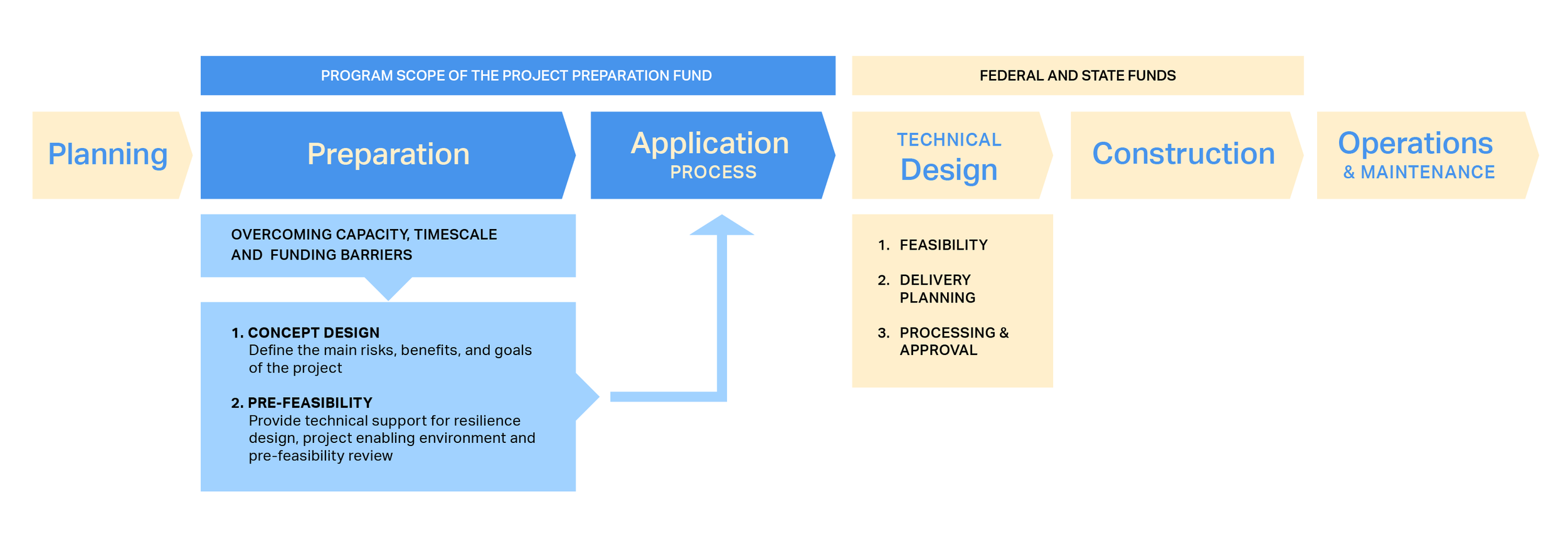
The Program identifies promising, community-supported projects and work with partners and key stakeholders to:

Create Stronger Project Narratives

Incorporate Additional Equity and Resilience Benefits

Mitigate Obstacles to Success

Identify State and Federal Funding Sources, Including Options for Meeting Local Match Requirements

Build Lasting Capacity to Develop Future Projects
Project leaders from selected communities may receive:

Assistance on writing competitive grant applications

Technical design and cost-benefit analysis support from leading global design and build firms

Capacity support in producing materials to help secure project funding, including a concept note and roadshow

Support for community engagement, including through small grants

Technical support in incorporating global best practices in project design in a way that best supports community needs
This program was funded to cover the following activities:
Project level kick-off sharing current state of project detail
Project diagnosis and planning for in-person workshops

Project Agenda Setting Workshop
Enhancing the impact story: Maturing the project goals
Mapping and understanding the Funding landscape
Community stakeholder input and design
High-level project work plan

Deeper project definition through Direct Technical Assistance
Could include:
Preliminary Design Drawings
Cost benefit analysis
Improved costing estimates & funding strategies
Enhanced project-benefits

Enhanced and competitive project narrative and roadshow
Clear funding roadmap
Federal and State Grant writing support
Action plan for next phases of project

OVERVIEW
The California Resilience Partnership’s Project Preparation Program (CRP-PPP) will support communities in advancing the equity- and resilience-building infrastructure projects that show the greatest promise for community impact—and preparing these projects to capitalize upon unprecedented levels of federal and state funding.
The passage of the federal Bipartisan Infrastructure Law and Inflation Reduction Act, and of California’s historic 2021 and 2022 State budget, have unlocked a once in a generation amount of federal and state resources to support critical infrastructure investments. The need for these investments has never been more urgent, as communities across the state face mounting existential climate risks and historic inequality only exacerbated by the pandemic. The CRP Project Preparation Program aims to ensure that communities most in need of these investments can overcome barriers in accessing them.
Phasellus pharetra aliquet viverra. Donec scelerisque tincidunt diam, eu fringilla urna auctor at.
Phasellus pharetra aliquet viverra. Donec scelerisque tincidunt diam, eu fringilla urna auctor at.
Phasellus pharetra aliquet viverra. Donec scelerisque tincidunt diam, eu fringilla urna auctor at.
ELIGIBILITY

CPPI supports local and regional public entities, non-profit organizations, and community based organizations that own and implement climate- and equity-focused infrastructure projects. Inaugural projects were based in the Greater Los Angeles and Sacramento regions in California.
PROJECTS

Project Size: Overall project cost between $5 million to $200 million
Infrastructure: Projects beyond planning stages that include an infrastructure component serving under-resourced populations and the public at large.
Climate Change & Equity: Projects address climate change through adaptive and/or mitigative measures, with particular attention to socio-economic inequities.

Local Leadership Commitment: Local leadership supports work and it's a local priority for state and/or federal funding.
Grounded in Community-Based Planning: Emerged from previous community-based planning efforts (like a general plan, resilience strategy, climate and resilience plans, or economic development plan).

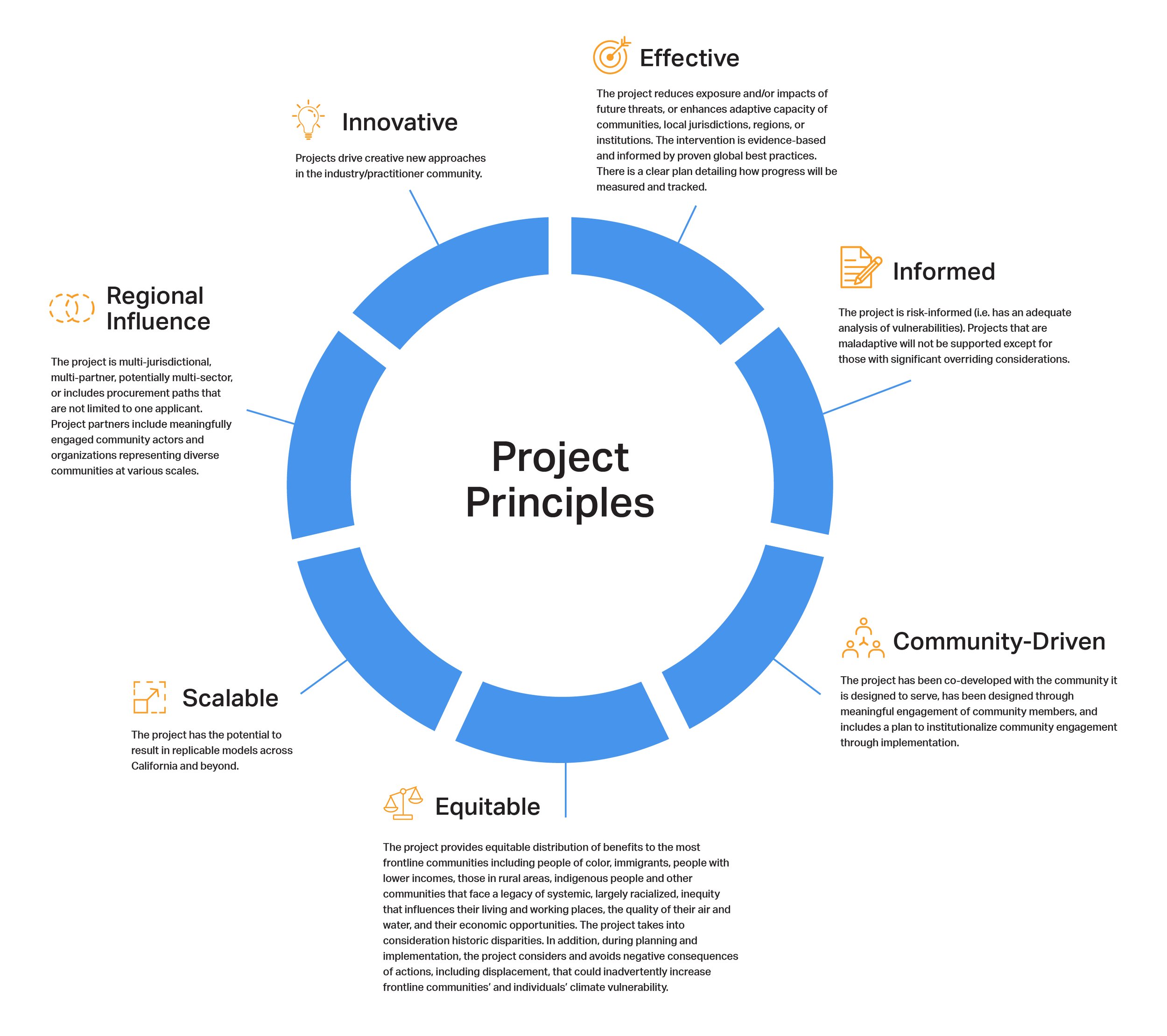
In addition, project owners will aspire to incorporate the following principles as part of this process:
PROJECT LEADERS


PROJECT SELECTION

All applications were reviewed by the Resilient Cities Catalyst (RCC) team, under the guidance of California Resilience Partnership's (CRP) Advisory Board.

NOMINATE A PROJECT

Please complete the form below to the best of your knowledge and provide relevant documentation as indicated or needed.
You can also view our FAQ section and/or reach out to us at contact@rcc.city.
Please note: This form cannot be saved and hence needs to be completed in one sitting. So we encourage project leaders to navigate through the form, collect all the information prior to submitting a response.
The maximum size for each file upload is 15MB and the total size limit for the form is 100MB. In case, the attachments are of maximum file size, please be patient for the files to upload after clicking the 'submit' button and do not refresh the page or all changes will be lost.
FAQs

Are private projects eligible for this program?
No. Only public climate and equity-focused infrastructure projects aiming to serve historically marginalized communities are eligible.
How does this program define “underserved,” “vulnerable,” and “low-income” communities?
The CRP Project Preparation Program is leveraging definitions from the following resources. Project leaders may use definitions other than those provided below; if so, please provide relevant documentation in the “Additional documents” section of the form.
- “Disadvantaged communities” as defined by CalEnviroScreen 4.0 (Health and Safety Code Section 39711);
- “Low-income communities”, as defined under the AB 1550 ‘Identification of Low-Income Communities’;
- “Disadvantaged communities”, as defined by SB 535 and as per the California Office of Environmental Health Hazard Assessment;
- Frontline communities and underrepresented communities, which are those that experience continuing injustice—including people of color, immigrants, people with lower incomes, those in rural areas, and indigenous people; and
- “Climate vulnerable communities,” as defined in the Governor’s OPR resource, Defining Vulnerable Communities in the Context of Climate Adaptation.
Are there existing tools that can be leveraged to identify vulnerable populations in my community?
Yes. Project leads may use any of the following tools to identify Vulnerable Communities. This is a non-exhaustive list, showing some of the most common vulnerability assessment tools in California.
- CalEnviroScreen 4.0 by the Office of Environmental Health Hazard Assessment (OEHHA)
- CalEnviroScreen 4.0, Healthy Places Index (HPI)
- Regional Opportunity Index (ROI)
- Climate and Economic Justice Screening Tool (J40)
- CalADAPT, and/or Climate Change and Health Vulnerability Indicators (CCHVI)
Is it mandatory for projects to prioritize serving vulnerable populations?
Yes. The goal of this program is to develop climate resilience and equity focused projects that support historically marginalized communities.
How does the program define resilience?
This team thinks about resilience as "the capacity of individuals, communities, institutions, businesses, projects, and systems within a community, city or region to survive, adapt, and thrive, regardless of the chronic stresses and acute shocks they experience.
What are ‘Shocks’ and ‘Stresses’?
A shock is a rapid-onset crisis or a severe climate event that has the potential to severely harm communities, systems, and natural ecosystems. Shocks are usually sudden and of a limited duration.
Examples include:
- Wildfire
- Earthquake
- Landslide
- Pandemic or public health emergency
- Extreme heat
- Tsunami
- Flooding
- Infrastructure failure
A stress is a chronic (ongoing or cyclical) natural or human-driven challenge that causes underlying or slow-burning harm to communities, systems, and natural ecosystems.
Examples include:
- Lack of affordable housing
- Poverty
- Systemic racism
- Aging or inadequate infrastructure
- Unemployment
- Homelessness
- Lack of social cohesion
- Economic inequality
- Sea level rise
- Grid vulnerabilities
- Invasive species
- Poor air quality
- Shifting macroeconomic trends
- Drought and water shortage
- Food insecurity
- Disparities in access to high-quality healthcare
- Disparities in access to high-quality education
- Environmental degradation
What are project ‘Co-benefits’?
Co-benefitsare defined as the capacity of projects and communities to leverage new and innovative socio-economic opportunities to reap multiple positive outcomes for the investment made beyond addressing the relevant shocks and stresses.
What is a ‘shovel worthy’ project?
Projects that don't just perpetuate the status quo but rather help communities build more equitable, sustainable and resilient communities